
MMA Odds Analysis and UFC Fight Betting
 Available in US
Nine years ago I placed my first UFC bet on a heavyweight underdog because a mate told me the bloke "looked angry at the weigh-in." I lost. The next week I lost again, this time on a favourite whose odds made him look like a sure thing. It took about six months of bleeding bankroll before I started treating fight betting the way it deserves to be treated: as a data problem, not a hunch machine.
That shift changed everything. Mixed martial arts wagering has exploded from a niche curiosity into a global market that now moves billions annually. The combined MMA and boxing betting market is valued at £1.5 billion, per Verified Market Reports, with projections pointing toward £3.2 billion by 2033. Total MMA handle alone reached £10.3 billion in 2024, a 17% jump year on year, per industry data compiled by Respect My Region. Those numbers tell you two things: the money is real, and the competition for edge is getting stiffer by the card.
This playbook is what I wish someone had handed me before that first reckless heavyweight punt. It covers the full landscape of UFC fight betting in the UK: odds formats, market types, the fighter statistics that actually predict outcomes, bankroll discipline, integrity safeguards and the regulatory framework that keeps the whole operation honest. Every claim is backed by data from first-party sources: TKO Group earnings, the UK Gambling Commission, UFC finish-rate databases and the words of people who run the sport. No recycled tipster wisdom, no vague advice to "do your research." Just the analytical toolkit a serious punter needs to make sharper decisions in the octagon betting market.
Core Strategies for UK UFC Wagering
- MMA wagering handle hit £10.3 billion in 2024. The market is deep enough for serious analysis, not just casual punts.
- Learn all three odds formats (decimal, fractional, American) and convert every price to implied probability before staking.
- Divisional finish rates vary wildly: nearly 50% KO/TKO in heavyweight, 66.9% decisions in women's strawweight. These baselines drive method of victory pricing.
- Flat stakes of 1-3% per bet protect your bankroll against the structural upset rate in combat sports.
- UFC's dual-layer integrity monitoring (IC360 and ProhiBet) exists because the risk of market manipulation is real. Factor line-movement anomalies into your pre-bet checklist.
How Big Is the UFC Betting Market
I remember a time when placing a UFC wager meant scrolling past three pages of football markets to find a single moneyline buried at the bottom of a sportsbook. That era is dead. The UFC generated £1.5 billion in revenue in 2025 with a profit margin of 57%, according to TKO Group Holdings' Q4 earnings report. The parent company's consolidated revenue, UFC plus WWE combined, reached £4.735 billion that same year, with EBITDA climbing 47% year on year. Combat sports are no longer a sideshow; they are a financial engine, and the betting market has grown in lockstep.
The global UFC market is valued at £1.74 billion in 2026, with forecasts projecting growth to £2.79 billion by 2033 at a compound annual growth rate of 8%, per Future Data Stats.
Zoom out further and the broader sports-betting landscape frames why octagon odds attract so much liquidity. Precedence Research estimates the global sports-betting market at £112.26 billion in 2025, heading toward £325.71 billion by 2035 at a CAGR of 11.24%. Within that universe, MMA wagering handle reached £10.3 billion in 2024, a 17% year-on-year increase that outpaced most traditional sports categories. The online segment accounts for 75% of all sports-betting activity and continues to grow at a CAGR of 10.3%, which means the vast majority of UFC punters are placing bets from a phone or laptop, not across a shop counter.

UFC Revenue 2025
£1.5 billion, 57% profit margin (TKO Group Holdings)
Global MMA Handle 2024
£10.3 billion, up 17% year on year
Global Sports Betting 2025
£112.26 billion, projected £325.71 billion by 2035
Online Share
75% of all sports-betting activity globally
These are not abstract projections. Every percentage point of growth translates into deeper markets, tighter lines and more bookmakers competing for UFC handle. For a punter, that competition is useful: it means more price variation between operators and more opportunity to find value before lines sharpen.
The UK's Place in MMA Wagering
The UK gambling industry turned over a gross gambling yield of GBP 16.8 billion in the year to March 2025, a 7.3% rise on the previous period, per the UK Gambling Commission. Remote casino, betting and bingo alone accounted for GBP 7.8 billion of that total, growing 13.1% year on year. Within this market, 8% of adults in Great Britain placed a sports bet online or via an app in the first quarter of 2025, according to the Commission's Gambling Survey for Great Britain. That 8% represents the addressable audience for UFC betting in this country: millions of active online punters, many of them already comfortable with in-play markets and mobile wagering.
The UK ranks among the top five global markets for UFC web traffic, contributing 6.84% of visits to ufc.com, per PlayToday's viewership analysis. UFC Fight Night London set a gate-revenue record of £4.71 million from 18,583 paid tickets, confirming that British appetite for live MMA translates directly into betting activity on domestic cards.
What makes the UK landscape distinct from the US or Australian markets is regulatory maturity. Every operator offering UFC odds to a British punter must hold a UK Gambling Commission licence, a requirement that comes with advertising restrictions, affordability checks and mandatory self-exclusion tools. The fixed-odds segment, which covers the majority of UFC pre-fight markets, holds 28.2% of the global sports-betting market share. For UK-based bettors, that regulatory wrapper means the playing field is at least structurally fair, even if individual odds still carry the bookmaker's margin.
UFC Odds Formats: Decimal, Fractional and American
A punter who cannot read odds in all three formats is already at a disadvantage. I say that as someone who spent his first year ignoring American moneylines because they "looked weird." Odds are the language of the market. If you only speak one dialect, you miss pricing signals from operators who default to another.
Decimal odds: the total return per unit staked, including the original stake. A price of 2.50 means a GBP 10 bet returns GBP 25 (GBP 15 profit plus the GBP 10 stake).
Decimal odds dominate UK sportsbook interfaces for UFC markets. They are the simplest format to compare: the higher the number, the bigger the underdog. Suppose a fighter is priced at 1.40. You stake GBP 10, and if the fighter wins, you collect GBP 14, a profit of GBP 4. Straightforward arithmetic, no mental gymnastics required. This is why most UK bookmakers default to decimals for MMA, even though fractional odds remain the traditional British format for horse racing.
Fractional odds: profit expressed relative to stake. Odds of 5/2 mean you profit GBP 5 for every GBP 2 wagered, plus your stake back.
Fractional odds still appear on some UK platforms, particularly those with roots in high-street betting. They work well for round numbers like 2/1, 5/1 and 10/1, but become unwieldy for the precise pricing UFC markets require. A decimal price of 1.83 converts to roughly 5/6, which is not intuitive for quick mental calculation. If you grew up with fractional odds on the horses, you can certainly use them for UFC, but be aware that decimal comparison is faster when you are scanning multiple operators for the best price on a single fight.
American odds (moneyline): these show how much you need to stake to win 100 units (negative number) or how much you win from a 100-unit stake (positive number). A price of -250 means you risk GBP 250 to profit GBP 100; a price of +200 means a GBP 100 stake profits GBP 200.
American odds are native to US sportsbooks, but they appear frequently in UFC coverage, previews and social-media discussion because the sport's heartland is American. If you follow MMA Twitter or read pre-fight analysis from US-based writers, you will encounter moneylines constantly. A significant share of global fixed-odds volume originates in jurisdictions that use American formatting, which means ignoring moneylines cuts you off from a substantial chunk of market intelligence. Learning to read them is not optional; it is part of being literate in the UFC betting ecosystem.
Same fight, three formats
Fighter A: decimal 1.50 | fractional 1/2 | American -200
Fighter B: decimal 2.75 | fractional 7/4 | American +175
A GBP 20 bet on Fighter B at decimal 2.75 returns GBP 55 (GBP 35 profit + GBP 20 stake).
The key skill is not memorising conversion formulas; any odds calculator handles that in seconds. The key skill is recognising that all three formats describe the same underlying probability, and that small differences in the third decimal place between operators can represent meaningful value over hundreds of bets. For a deeper breakdown of each format with worked examples, the full guide to UFC betting odds explained walks through every conversion step.
Converting Odds to Implied Probability
Every price a bookmaker offers is really a probability estimate wearing a disguise. Strip away the format and what remains is the market's answer to a simple question: how likely is this fighter to win? That answer is called implied probability, and it is the single most useful concept in fight betting.
Decimal odds to implied probability
Formula: implied probability = 1 / decimal odds x 100
Fighter A is priced at 1.50. Implied probability = 1 / 1.50 x 100 = 66.7%.
Fighter B is priced at 2.75. Implied probability = 1 / 2.75 x 100 = 36.4%.
Combined implied probability: 66.7% + 36.4% = 103.1%.
The 3.1% above 100% is the bookmaker's overround, the built-in margin that guarantees the operator a profit regardless of the outcome.
Why does this matter? Because if you believe Fighter B has a 42% chance of winning based on your own analysis, but the market implies only 36.4%, you have identified a potential value bet. The price is longer than it should be. Conversely, if you think Fighter A wins 60% of the time but the market implies 66.7%, the favourite is overpriced relative to your estimate. This gap between your probability and the market's probability is where every profitable UFC bettor operates.
The discipline is not about being right on every fight. It is about consistently finding spots where your probability estimate exceeds the implied probability, then staking accordingly. Over hundreds of bets, that edge compounds. Without implied probability as your anchor, you are just picking winners, and picking winners at bad prices is a reliable way to lose money slowly.
Core Betting Markets in UFC
The first time I opened a UFC betting slip and saw twelve different market tabs, I froze. Moneyline, method of victory, round betting, totals, fight props, double chance. It looked like a spreadsheet, not a bet. But here is what nobody tells beginners: you do not need all of those markets. You need to understand what each one measures, pick the two or three where your analysis has genuine traction, and ignore the rest.
Moneyline (Fight Winner)
Pick the winner. The simplest market and the highest-volume one on every UFC card.
Method of Victory
Bet on how the fight ends: KO/TKO, submission, or judges' decision. Requires divisional finish-rate knowledge.
Round Betting (Over/Under Totals)
Wager on whether the fight exceeds or falls short of a specified round threshold, typically 1.5 or 2.5.
Fight Props
Specific outcomes: fight to go the distance, significant strikes over/under, takedown props and novelty markets.
The moneyline is where most UFC bets land, and for good reason. You are answering one question — who wins — and the pricing is transparent. But it is also the market where bookmakers are sharpest, because it attracts the most volume and the most sophisticated bettors. If you want edges on the moneyline, you need to be better than the crowd at estimating win probability.
Method of victory: a market that splits the outcome into three (sometimes four) categories: KO/TKO, submission and decision (with some operators adding draw or no contest).
Method of victory is where divisional data becomes a weapon. The overall UFC finish rate sits at roughly 53%, with KO/TKO significantly outpacing submissions, per MMA.Social's finish-rate database. In the heavyweight division, nearly 50% of fights end by knockout or technical knockout, and only 28.6% go to the judges' scorecards — the lowest decision rate in the entire promotion. If you are betting method of victory on a heavyweight bout without knowing those baselines, you are pricing blind. A full breakdown of how to use UFC method of victory betting by weight class is covered separately.
Round betting and fight props occupy the thinner end of the market. Fewer punters trade these markets, which means bookmaker lines can be softer, but the variance is higher and the sample sizes for back-testing are smaller. Over/under 1.5 rounds on a heavyweight fight has a very different probability profile than over/under 2.5 rounds on a women's strawweight bout, where 66.9% of fights reach a decision. Understanding those divisional baselines is not optional; it is the foundation of intelligent market selection.
My advice for anyone starting out: master the moneyline and method of victory markets first. They are where the data is richest, the liquidity is deepest and the learning curve delivers the fastest returns. Props and round bets are sharpening tools, not starting points.
Octabet proprietary tool
The Method Gap
Divisional finish-rate baselines against the bookmaker's method-of-victory prices. The tool strips the overround out of the three-way market, rebuilds the probabilities from the weight class upward, and shows exactly where the price disagrees with the division.
1 · Weight class
KO/TKO 50.0% Sub 21.4% Dec 28.6%
2 · Bookmaker prices
3 · Matchup tilt
Bookmaker margin on this three-way market: 4.6%
Best gap: Submission at +5.5 pp — the market prices 15.9%, the division-adjusted model says 21.4%. Fair price 4.67 against 6.00 offered. Flat 2% stake: £20.00.
Baselines are historical UFC divisional finish rates (KO/TKO, submission, decision). The model tilts those baselines by your matchup read and normalises to 100%; it does not predict individual fights. A gap of at least 2.0 percentage points is treated as actionable. Always compare the fair price against several licensed operators before staking. 18+ · gamble responsibly.
Five Fighter Statistics That Move the Needle
DRatings, one of the more respected MMA analytics platforms, put it bluntly: "UFC can be particularly challenging in a variety of ways. First, combatants can go months or years without fighting. Second, some fighters have very few fights under their belts or join UFC from another federation where our data is limited." That is not a reason to abandon statistics — it is a reason to use them carefully, with an awareness of context that most competitors in the top ten search results ignore entirely.
Striking Output
Significant strikes landed per minute — the volume metric that separates pressure fighters from counter-strikers.
Striking Accuracy
Percentage of strikes that land. High accuracy combined with low output often signals a patient counter-fighter.
Striking Defence
Percentage of opponent strikes avoided. Durability is not the same as defence; a fighter can absorb punishment and still lose on the cards.
Takedown Accuracy
Percentage of attempted takedowns that succeed. Controls pace and dictates where the fight takes place.
Takedown Defence
Percentage of opponent takedowns stuffed. A wrestler with 90%+ takedown defence is a different proposition than one at 65%.
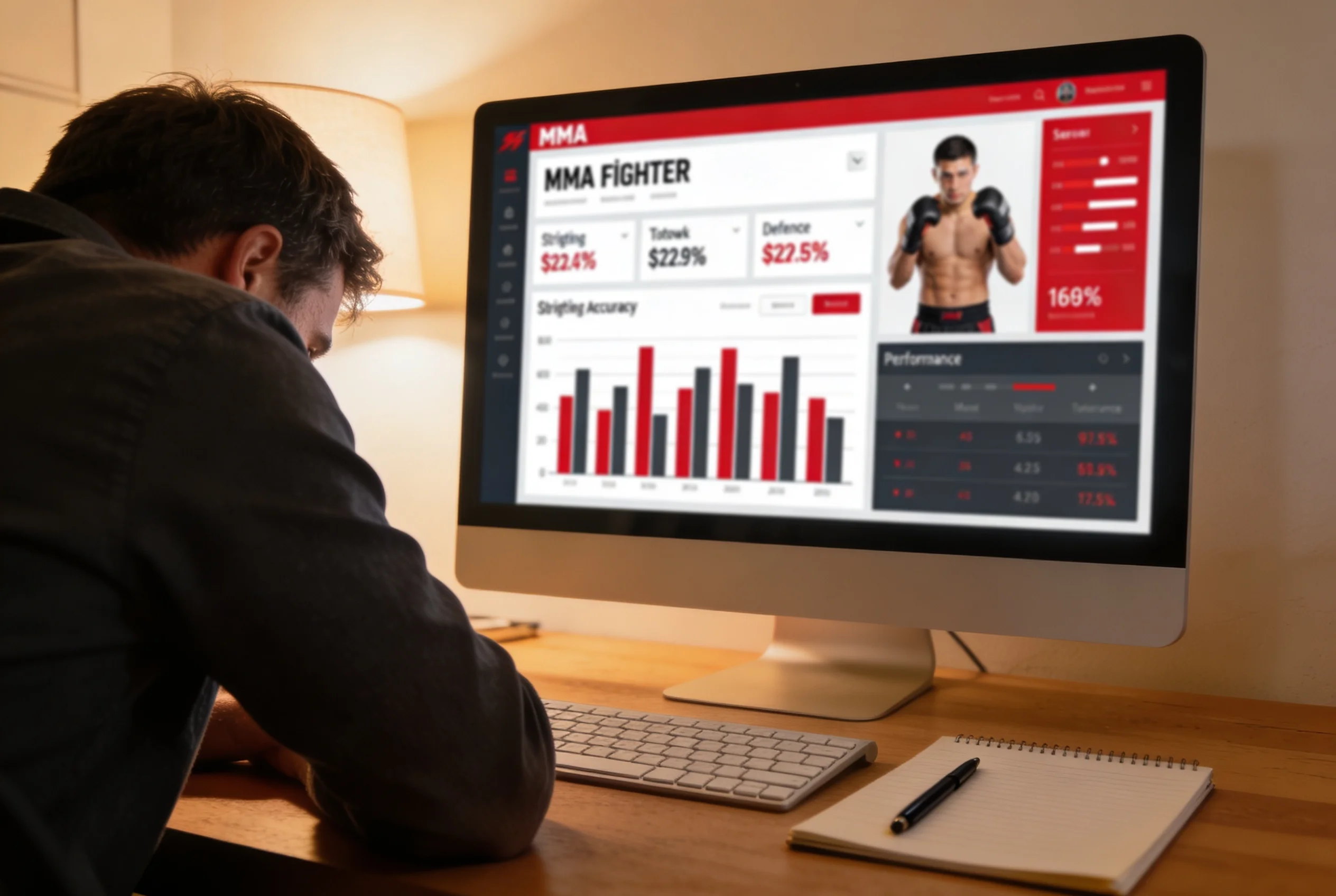
None of these numbers means much in isolation. A striker landing 6.5 significant strikes per minute sounds devastating until you learn their opponent absorbs shots at the lowest rate in the division. Context is everything. When I build a pre-fight profile, I layer these five statistics against each other and against the divisional baseline. In the middleweight division, for example, KO/TKO accounts for 36.9% of finishes, submissions for 21.8%, and decisions for roughly 40%, making it the least predictable weight class in the promotion, per Bodyslam.net. A middleweight bout between two fighters with similar striking output but radically different takedown defence tells you far more about probable method of victory than the raw numbers alone.
Heavyweight Profile
Among heavyweights who finish fights, 70% of those finishes come via strikes (KO/TKO), with only 30% by submission. Decision rate: 28.6%, the lowest in the UFC. Striking output matters most; grappling is secondary unless you are analysing a specific wrestling-heavy matchup.
Women's Strawweight Profile
Only 13.4% of bouts end by KO/TKO. Decision rate: 66.9%, the highest in the promotion. Takedown accuracy and control time become dominant predictive factors because most fights go to the scorecards.
The trap most bettors fall into is treating these statistics as fixed attributes of a fighter rather than as context-dependent tendencies. A striker's output drops when facing a relentless wrestler who closes distance early. A grappler's takedown accuracy craters against an opponent with elite sprawl. The five metrics above are starting points, not conclusions. Your job is to model how they interact in a specific matchup, then compare your estimate against the price the market is offering. That gap, if it exists, is where the bet lives.
For a detailed methodology on weighting each metric within your matchup analysis, the UFC betting strategy framework breaks the process into phases.
Bankroll Discipline for Combat-Sports Bettors
I have watched sharp analysts, people who genuinely understand MMA matchups, go broke because they could not keep their hands off the stake slider. There is a particular trap in combat sports that does not exist in football or cricket: the emotional volatility of a fight. A single punch can flip a bout in half a second, and if you have overcommitted on a favourite who just got clipped, the urge to chase on the next fight is almost irresistible. "Underdogs in the sport of mixed martial arts are more likely to deliver an upset than in just about any other sport," as one campus sports column at Allegheny put it. That structural unpredictability is exactly why bankroll discipline matters more here than in any league with 82-game seasons.
Combat sports have no regular season. UFC cards come in clusters, and a bad run of three or four events can wipe weeks of careful analysis. Your bankroll rules must survive variance, not just average performance.
The foundational principle is simple: never risk a percentage of your bankroll that you cannot absorb losing ten times in a row. For most punters, that means flat stakes of 1-3% per bet. A GBP 1,000 bankroll with a 2% unit size means GBP 20 per wager, regardless of how confident you feel about the fight. Confidence is not a staking plan; it is a cognitive bias in disguise.
Percentage staking adjusts automatically as your bankroll grows or shrinks. You bet 2% of whatever the current balance is, so a losing streak reduces your exposure without requiring manual intervention. The Kelly Criterion offers a mathematically optimal approach by sizing stakes in proportion to your estimated edge, but it demands accurate probability estimates that most recreational bettors cannot reliably produce. In nine years of MMA betting, I have met exactly two people who use full Kelly consistently, and both of them run spreadsheet models that would make a quant analyst nod approvingly.
Do
- Set a fixed unit size before the card starts and stick to it for every bet that night.
- Pre-allocate a session bankroll for each UFC event, separate from your main bankroll.
- Track every bet with the odds, stake, result and your pre-fight probability estimate.
- Review your record after every 50 bets, not after every card.
Don't
- Increase stakes after a loss to "make it back" on the co-main event.
- Bet on every fight on a card because you "have a feeling" about the prelims.
- Use winnings from one fight to fund a larger stake on the next without recalculating your unit size.
- Treat parlays and accumulators as free-roll entertainment. They are bets with compounding risk.
The goal of bankroll management is survival. If you survive long enough with a genuine analytical edge, the maths takes care of the rest. If you blow up your bankroll in month two because you chased a bad beat on a Fight Night undercard, no amount of statistical knowledge will help you.
Betting Integrity: How UFC Polices the Market
In early 2026, Dana White pulled a fight from UFC 324 because the gaming integrity service flagged suspicious betting activity. His response was characteristically blunt: "We got called from the gaming integrity service and I said, 'I'm not doing this s--- again,' so we pulled the fight." That willingness to cancel a bout on a pay-per-view card, absorbing the promotional cost and the fan backlash, tells you something about where the organisation's priorities sit right now. Integrity is not a public-relations exercise. It is a commercial necessity for a sport that depends on betting revenue.
UFC has partnered with IC360 (Integrity Compliance 360) since January 2023 to monitor wagering activity across every event. A second partnership with ProhiBet launched in September 2023, creating a dual-layer surveillance system that cross-references betting patterns with fighter and corner connections. The UFC's official position, issued during the Dulgarian-Del Valle scandal, stated: "Along with the health and safety of our fighters, nothing is more important than the integrity of our sport."
The structural vulnerability is real, though, and it starts with money. UFC fighters earn approximately 16-20% of organisational revenue, compared with 50% in the NBA, NFL and NHL, according to an analysis by Respect My Region. When a prelim fighter on a GBP 12,000 show purse gets approached with an offer worth double or triple that amount to manipulate a round or a method of finish, the economics create pressure that does not exist in better-compensated leagues. Veteran MMA journalist Ariel Helwani has spoken about fighters being "offered double and triple what the UFC pays them," calling those offers tempting for athletes at the lower end of the pay scale.

For punters, integrity risk is a pricing variable, not just an ethical concern. If a line moves sharply without any public information to explain the shift, with no injury news, no training-camp changes, no weigh-in drama, that movement itself becomes a data point worth investigating before you stake.
None of this means the sport is riddled with corruption. The monitoring infrastructure is more robust than it has ever been, and the willingness to pull fights at late notice sends a credible deterrent signal. But pretending the risk does not exist is naive, particularly on undercards and international Fight Night events where handle is lower and line movements are easier to influence. A full analysis of UFC betting integrity — including recent cases, the IC360 monitoring process and red flags punters can spot — is covered in depth elsewhere on this site.
UK Regulation and Responsible Gambling
Baroness Twycross, the UK Minister for Gambling, stood up at the Betting and Gaming Council's annual general meeting and said she had "tasked the industry with doing more to work together to ensure that gambling advertising and sponsorship is appropriate, responsible, and does not exacerbate harm." That was not a suggestion. It was a directive from the department that writes the rules, and it reflects a regulatory environment that has tightened significantly for anyone wagering on UFC in Britain.
Since 9 April 2025, online slot stake limits in Great Britain have been capped at GBP 5 per spin for those aged 25 and over, and GBP 2 for the 18-24 age bracket. While these limits apply specifically to slots rather than sports betting, they signal the direction of travel: the Gambling Commission is actively intervening in product design to reduce harm, and sports-betting markets are not immune to future constraints.
The remote casino, betting and bingo sector generated GBP 7.8 billion in gross gambling yield for the year ending March 2025 — a 13.1% increase, per the UK Gambling Commission. That growth attracts scrutiny. Every operator licensed to offer UFC odds in the UK must comply with the Gambling Act 2005 as amended, hold a UKGC operating licence and meet ongoing conditions around customer interaction, affordability checks and anti-money-laundering controls. The Betting and Gaming Council estimates that GBP 2.7 billion is wagered annually on unlicensed sites in Great Britain, roughly 2% of the licensed market, which underlines why sticking with regulated operators is not just a legal preference but a practical safeguard for your funds.
Before You Place a UFC Bet in the UK
- Confirm the operator holds a current UKGC licence — check the Commission's public register.
- Complete KYC (Know Your Customer) verification: photo ID, proof of address, source-of-funds documentation if requested.
- Set deposit limits, loss limits and session time reminders in your account settings before the first fight night.
- Review the operator's self-exclusion and cooling-off options — these must be available under UKGC licence conditions.
- Understand that UK gambling winnings are not taxed for the punter — the operator pays the point-of-consumption tax, not you.
Responsible gambling is not a footnote. The Commission's own survey data shows that 39% of adults in Great Britain participated in some form of online gambling in the four weeks before being surveyed, a figure that drops to 16% when lotteries are excluded. Within that population, problem gambling affects a small but significant minority, and UFC's young, male-skewed demographic overlaps heavily with the cohort most at risk. If your betting feels like it is shifting from entertainment to compulsion, if you are chasing losses, hiding stakes from family or betting money you cannot afford to lose, the National Gambling Helpline and GamCare offer confidential support.
Who Bets on UFC — and Why It Matters
Knowing who else is in the market changes how you read the lines. If you picture the typical UFC bettor as a grizzled sharp with a probability model on a dual-monitor setup, you are thinking of a tiny fraction of the audience. The reality is far more casual, and that casualness creates exploitable pricing patterns.
UFC's audience is 75% male and 25% female, with the largest age cohort falling between 25 and 34 years old, according to Similarweb analytics for ufc.com. Forty percent of UFC fans are millennials, per PlayToday's viewership data, a demographic that bets more frequently on mobile and gravitates toward in-play markets.

In the United States, 21% of adults aged 18-34 identify as avid fans of combat sports, per Morning Consult data reported by Statista. That enthusiasm does not automatically translate into betting sophistication. When a casual fan backs a name they recognise at short odds because they watched a highlight reel on social media, they are contributing to a pricing bias that overvalues famous fighters and undervalues lesser-known opponents. The public money flows toward narratives, toward comeback stories, grudge matches and knockout artists, and it inflates favourites beyond what the data supports.
For the data-driven punter, this audience composition is valuable intelligence. A card headlined by a household name will attract heavier casual volume, which pushes the favourite's price down and extends the underdog's price outward. The deeper the public's emotional attachment to a fighter, the wider the potential gap between implied probability and actual probability. Conversely, a Fight Night card featuring lesser-known athletes generates thinner handle and less public bias, which means the lines tend to be sharper from the start. Less opportunity for value, but also less noise to filter through.
The global MMA fan base exceeds 300 million people, per Cage Walks demographic data, and the UFC has staged events in 28 countries. In the UK, the combination of favourable time zones for European cards, a mature regulatory framework and a growing domestic fight scene means the betting audience is both engaged and expanding. Understanding that audience, its biases, its patterns, its emotional triggers, is as much a part of fight analysis as studying takedown defence or striking accuracy.
Sharper Analysis, Fewer Blind Punts
Every section above, from market size to audience demographics, feeds into a single operational question: where does the price the bookmaker offers diverge from the probability your analysis suggests?
I started this guide by describing a bad bet on a heavyweight underdog driven by nothing more than a weigh-in impression. Nine years later, that kind of bet still exists on every card, placed by someone who trusts vibes over data, who does not know the divisional finish rates, who has never calculated an implied probability. The difference between that punter and a serious analyst is not intelligence or access to secret information. It is process.
Process means checking the five fighter statistics that predict outcomes before you form an opinion. It means converting the bookmaker's price to implied probability and comparing it against your own estimate. It means applying flat-stakes discipline even when every instinct tells you to load up on a fighter you "know" will win. It means acknowledging that the UFC's integrity framework exists because the sport faces real structural vulnerabilities — and factoring that awareness into your risk management.
The UK market gives you a strong foundation: regulated operators, no tax on winnings, deep liquidity on major cards and a growing selection of in-play and prop markets. What the market does not give you is an edge. That you have to build yourself, fight by fight, card by card, through rigorous analysis and honest record-keeping.
The punters who survive long-term in UFC betting are not the ones who pick the most winners. They are the ones who consistently find prices that underestimate probability, and who have the bankroll discipline to stay in the game long enough for the maths to work.
If this playbook has done its job, you now have a framework for approaching every UFC card with a structured methodology rather than gut instinct. The UFC live betting guide covers real-time wagering in more depth for those ready to add in-play markets to their toolkit.
Frequently Asked Questions
Is UFC betting legal in the UK?
Yes. UFC betting is fully legal in the United Kingdom for anyone aged 18 or over. All operators offering UFC markets to UK residents must hold a licence from the UK Gambling Commission under the Gambling Act 2005. This licence requires compliance with advertising standards, customer-interaction protocols and anti-money-laundering checks. The punter's responsibility is to use a licensed operator — the Commission maintains a public register where you can verify any bookmaker's licence status before opening an account.
What types of bets can you place on UFC fights?
The main markets are moneyline (picking the fight winner), method of victory (KO/TKO, submission or decision), round betting (over/under total rounds or exact-round props) and fight props (such as fight to go the distance, significant strikes totals and takedown-related outcomes). Most UK bookmakers also offer bet-builder tools that let you combine multiple selections from the same fight into a single wager. The moneyline is the simplest and highest-volume market; method of victory and round betting require deeper understanding of divisional finish rates and fighter profiles.
How do UFC betting odds work in decimal and fractional format?
Decimal odds show your total return per unit staked, including the original stake. A price of 2.50 means a GBP 10 bet returns GBP 25. Fractional odds show profit relative to stake: 3/2 means you profit GBP 3 for every GBP 2 wagered, plus your stake back. Both formats express the same underlying implied probability. Decimal is simpler for quick comparison, while fractional remains traditional in some UK betting contexts. To convert decimal to fractional, subtract 1 from the decimal price and express the result as a fraction.
Can I bet on UFC fights live (in-play)?
Yes. Most UK-licensed bookmakers offer in-play betting on UFC events, with markets that update between rounds and sometimes within rounds. Available in-play markets typically include next-round winner, updated moneyline, method of victory and total rounds. Odds shift rapidly after significant moments, such as a knockdown, a submission attempt or a dominant round, and latency between the live broadcast and the bookmaker's feed can vary by platform. In-play UFC betting demands faster decision-making and tighter risk controls than pre-fight wagering.
Are UFC betting winnings taxed in the UK?
No. Under the UK's point-of-consumption tax regime, the operator pays the gambling duty, not the punter. Your UFC betting winnings are tax-free regardless of the amount. This applies to all forms of legal gambling with UK-licensed operators. The total gambling and betting duty collected by HMRC was GBP 714 million for the 2024-2025 financial year, but that cost sits entirely on the bookmaker's side of the ledger.
What statistics should I look at before betting on a UFC fight?
Five metrics form the core of a pre-fight statistical profile: striking output (significant strikes landed per minute), striking accuracy (percentage of strikes that connect), striking defence (percentage of opponent strikes avoided), takedown accuracy (successful takedowns as a proportion of attempts) and takedown defence (opponent takedowns stuffed). These numbers should always be assessed in context, against the divisional baseline and against the specific opponent's profile, rather than treated as fixed ratings. A fighter with high striking output facing an elite counter-striker will perform differently than against a pressure wrestler.
How does the method of victory market work in UFC betting?
The method of victory market asks you to predict not just who wins, but how they win. Typical options are KO/TKO (strikes), submission (grappling finish) and decision (judges' scorecard). Some operators split decision into unanimous and split, or add draw/no contest as a selection. Pricing reflects the divisional baseline: heavyweight bouts, where nearly 50% of fights end by KO/TKO, will price the knockout option shorter than in women's strawweight, where only 13.4% of fights end by strikes and 66.9% reach a decision. The method market offers wider margins than the moneyline because bookmakers have less volume to sharpen the lines against.
